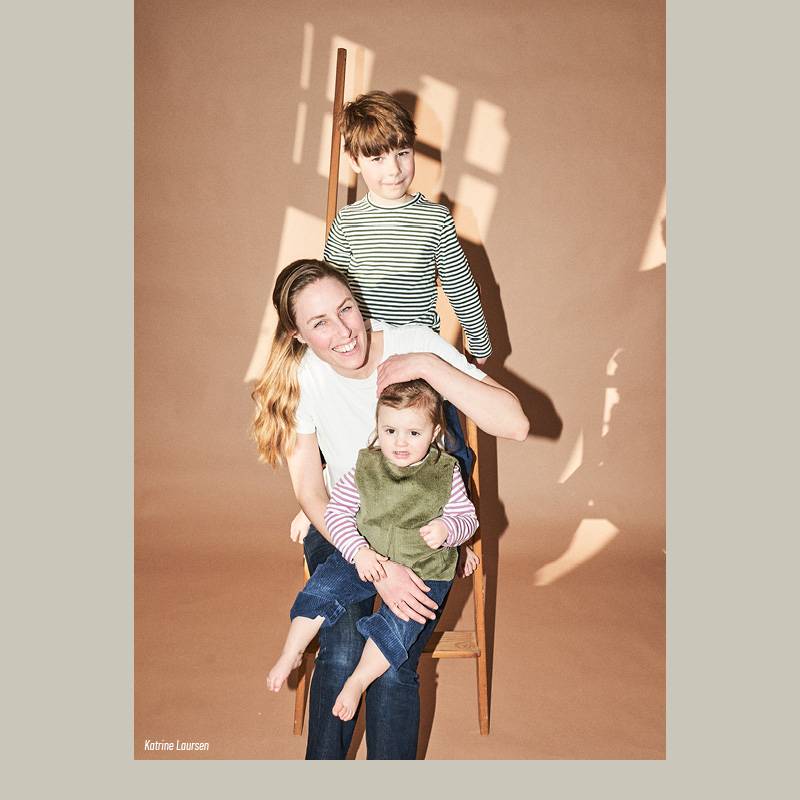

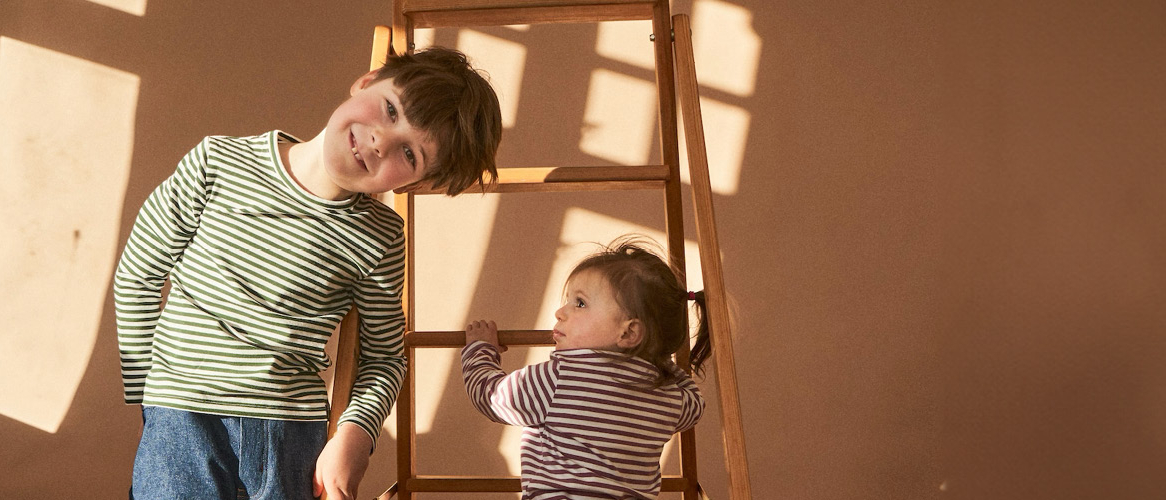
Founder and designer Katrine Laursen rethinks sustainability in the launch of her new children’s clothing brand Flab. Thoughtful functions and practical details give the children’s clothing longer durability, while being unisex and featuring a strong design expression.
When Katrine Laursen was expecting her second child, a girl, she looked through the saved children’s clothes in Ikea bags from when her son was little:
“It struck me that I could hardly reuse any of the clothes for my daughter. They were very gender stereotypical. Therefore, it’s important for me to design styles that can be used regardless of gender. This way, one doesn’t need to buy a new wardrobe when having a child of a different gender, and things can be handed down.”
In Flab’s first collection, you’ll find jeans and sweatshirts that are gender neutral. However, there’s careful thought into adapting the clothes to each child:
“I thought about it so that one can buy the children’s clothes oversized and use a sweatshirt as a dress, for example. My daughter is 2 years old and wears size 4 years. In this way, the girl’s clothing is also thought into it,” says Katrine Laursen, who is educated as a design technologist.



She started making children’s clothing for her son, feeling that much of the boys’ clothing in shops lacked diversity and colour. And when she had a girl, she thought it would be much easier to find nice girls’ clothing. Here, she found that it was either very ‘girly’ or completely beige. She herself missed joy and playfulness in children’s clothing in a cool way.
For Katrine Laursen, it’s also about much more than colours. The foundation of Flab stems from the desire to rethink sustainability in a new way. It’s crucial for her that children’s clothing can be used again and again, so all details are well-thought-out:
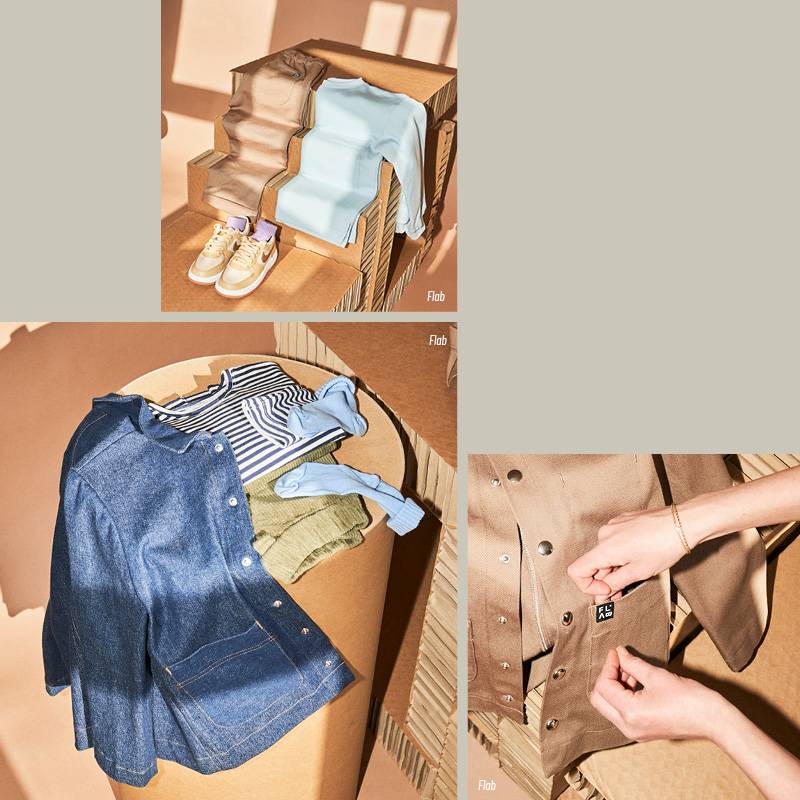
“All the clothes have different details, making it possible to adjust the size and fit for each child. All sweatshirts come with elastic in the sleeves, so one can adjust the length. Similarly, all trousers come with waist adjustment and a wide turn-up at the legs, allowing the trousers to be lengthened by up to seven centimetres.”
Similarly, all styles from Flab also come with an accompanying badge, attached to the garment’s hangtags. These badges are intended as a small patch for the clothing and can easily mend a hole or become part of the design if the child wishes. Katrine Laursen also bases her design on her own life as a mother of two young children:
“I have made a sweatshirt that has no front or back. So, the child can’t put it on the wrong way, and it gives more independence. It also helps slightly stressed parents in the morning,” she adds with a laugh.
Sustainability in new clothing
For Katrine Laursen, sustainability is not a buzzword or a random choice. It’s incorporated into the company on many different levels. The factory in Turkey, which produces the collection, was also carefully selected after much research and visits – and precisely meets the desire for a shared sustainable value base:
“I don’t want bulging inventories. If there is a style that doesn’t sell well, it can be included in the next collection with a twist. It can involve converting trousers into shorts if they are already in stock.”
The founder will also break with the many traditional collection drops, as the clothing is designed to be used all year round, with children wearing it more in layers. A denim jacket from Flab can function both as a summer jacket and as a cardigan indoors.
“Right now, my biggest focus is to find good ambassadors for Flab in the form of stores that want to sell the clothing. Precisely because the clothing contains different functions and practical details, it requires stores that can showcase it and understand my mission that we should buy small but good and rethink sustainability in our children’s wardrobes.”